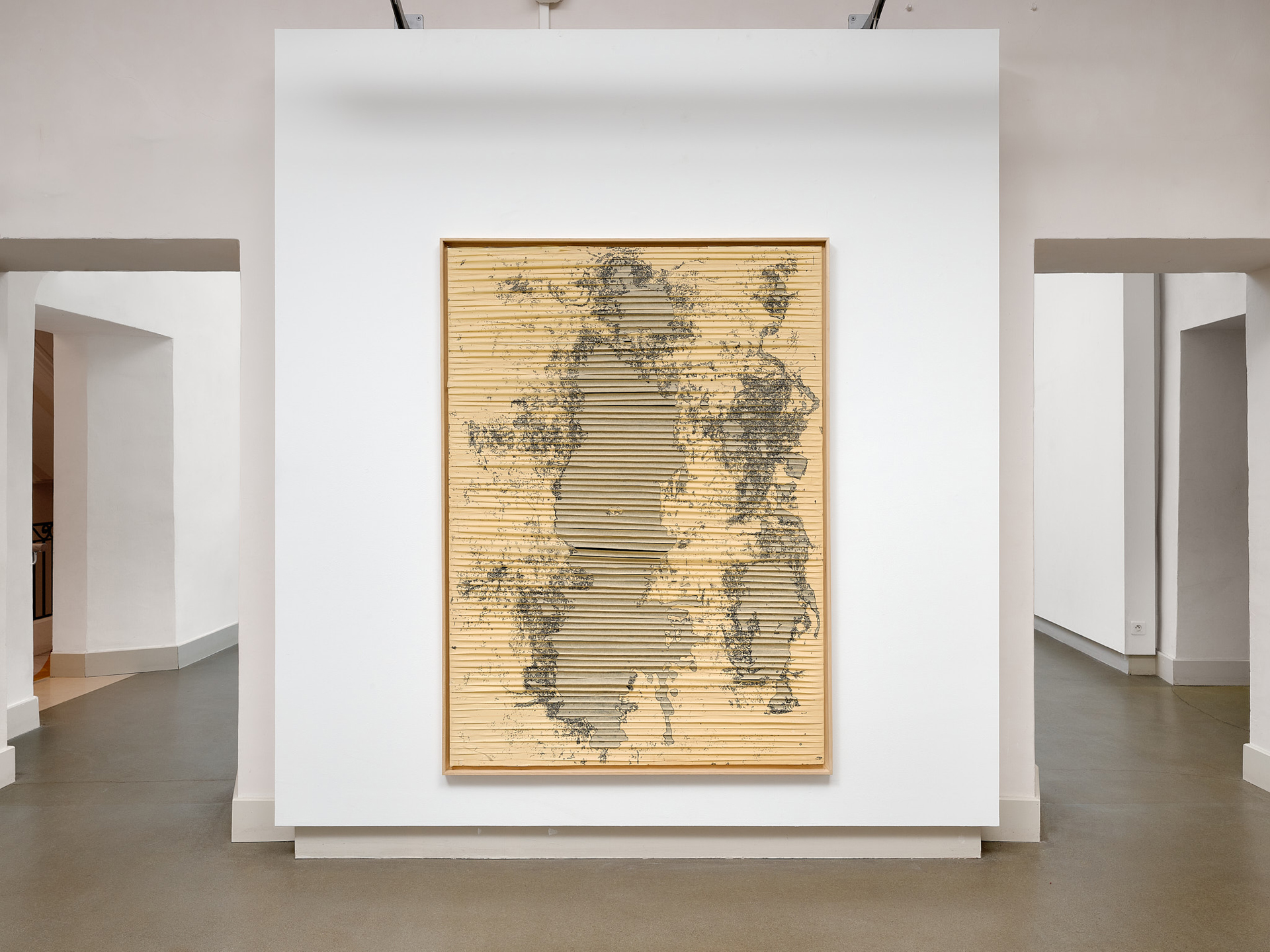
photo réalisée par Francois Fernandez lors de l’exposition Le choeur de l’aube au CIAC
Point aveugle
2011
Papier Canson marouflé, scotch de peintre, encre de Chine et Posca.
Dans Point aveugle, Amandine Rousguisto transpose la pensée lacanienne dans un geste pictural et presque performatif. Le point de départ est une matrice à l’encre de Chine, surface de travail dont elle ne retient que des fragments : elle retire, sélectionne, garde ce qui échappe au contrôle. Ce geste de retrait et de choix intuitif correspond à la dynamique du regard lacanien : l’artiste ne cherche pas à maîtriser l’image, mais à laisser apparaître ce qu’elle ne sait pas encore voir.
Chez Amandine Rousguisto, ce point devient espace de création : aller vers ce qu’on ne connaît pas, accepter de se laisser guider par ce qui échappe à la conscience. La matière (l’encre, le papier, le scotch de peintre) agit alors comme médiateur du langage de l’inconscient. En recouvrant, en masquant, en gainant, elle révèle paradoxalement une forme émergente, une présence née du retrait.
Ainsi, Point aveugle n’est pas une composition volontaire, mais une exploration du non- savoir : l’artiste se place dans la position du sujet lacanien, travaillant à partir du manque, de ce qui ne se voit pas, pour faire advenir une image qui regarde à son tour.
Commissaire d’exposition et directrice du CIAC,
Christine Enet
In Point aveugle, Amandine Rousguisto translates Lacanian thought into a pictorial, al- most performative gesture. The starting point is an ink matrix, a working surface from which she retains only fragments: she removes, selects, and preserves what escapes control. This act of withdrawal and intuitive choice mirrors the Lacanian gaze: the artist does not seek to master the image but allows what is yet unseen to emerge.
For Rousguisto, the point becomes a creative space: moving toward the unknown and letting oneself be guided by what escapes conscious control. Materials—ink, paper, painter’s tape—serve as mediators of the unconscious. By covering, masking, and sheathing, she paradoxically reveals an emerging form, a presence born from what is re- moved.
Point aveugle is thus not a deliberate composition but an exploration of non-knowledge: the artist positions herself as the Lacanian subject, working from absence and the un- seen to bring forth an image that, in turn, observes.
Exhibition curator and director of the CIAC,
Christine Enet
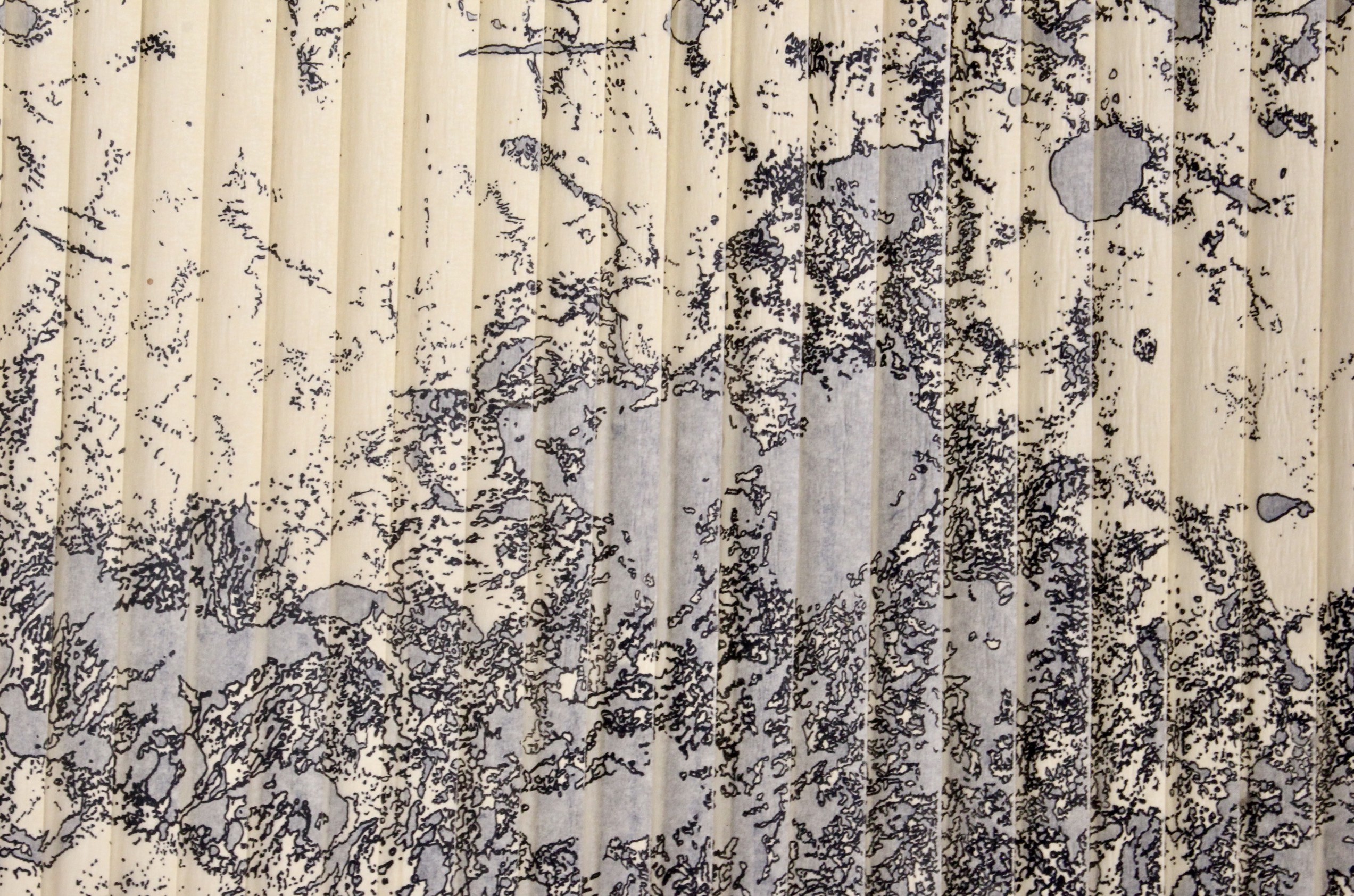
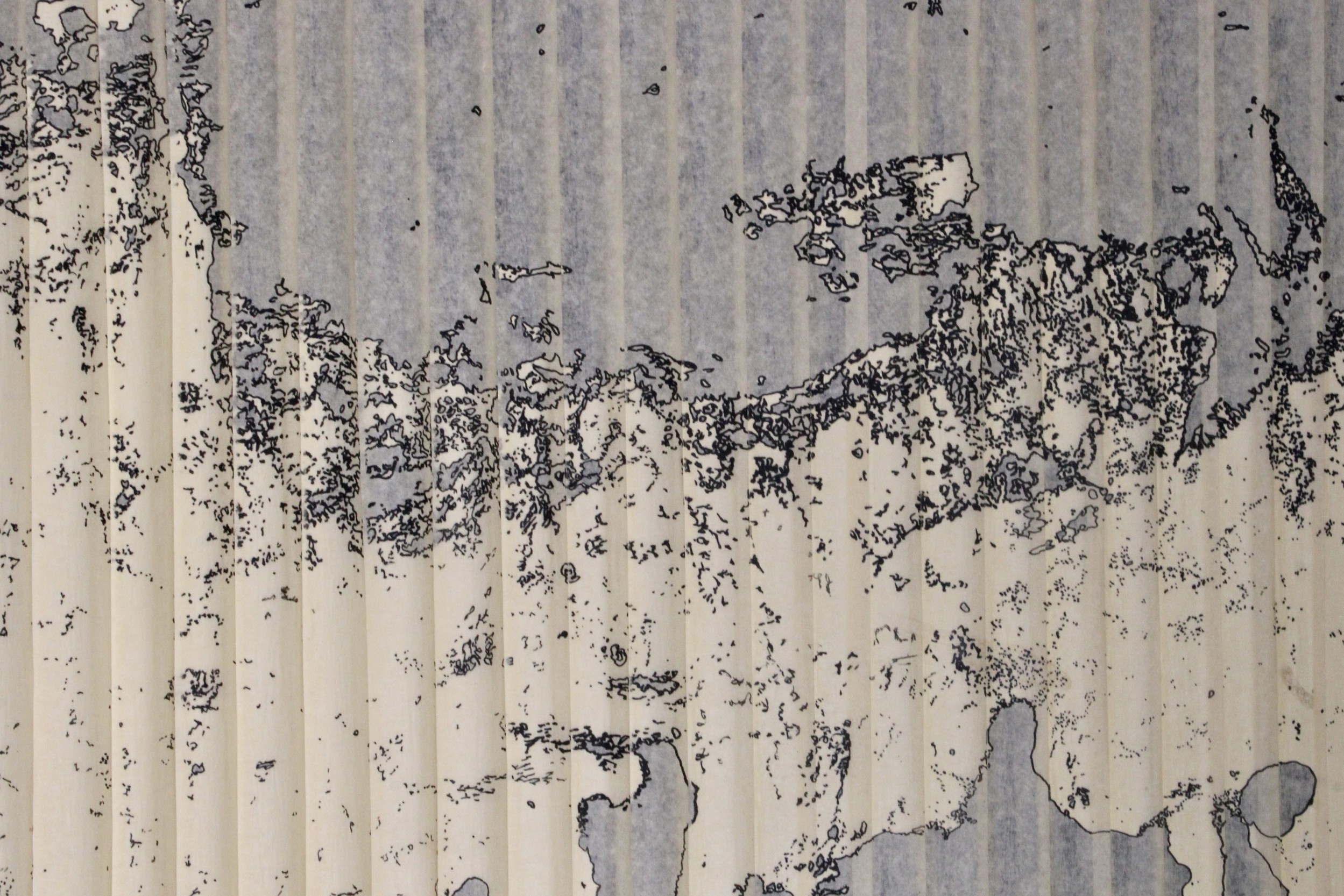
Point aveugle
Papier Canson marouflé, scotch de peintre, encre de chine et Posca
Suite entamée en 2010